The Fall 23 edition of The Tributary was created to prove that art and creativity can be found in everyone. As The Tributary grows and we proceed in a digital format, we decided there is no need for editors to submit their own work. Instead, it is much more valuable to showcase the diverse voices at Lycoming College; most of the featured writers and artists in this edition are not creative writing majors. The pieces featured are deep, they deal with identity and interactions, family, and vulnerability. Ultimately, this connection depicts an array of humanism and we hope you enjoy!
Fallen, Tea, and Pictures by Max Wilhelm
Fallen
by MK
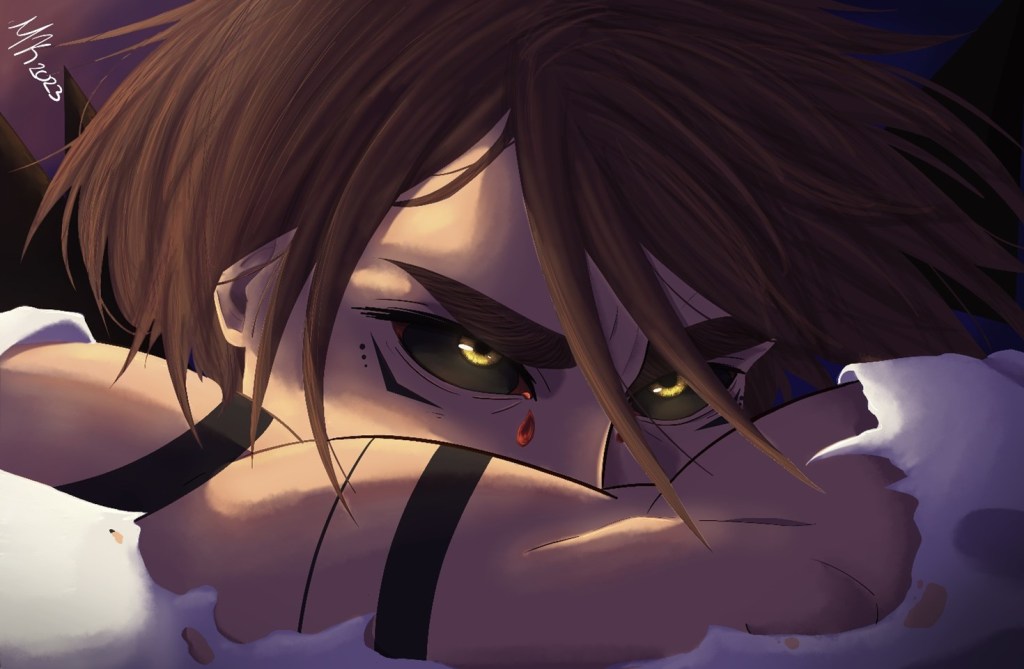
Sarah Madison Kracker, MK, is a first year and has plans to double major in Creative Writing and Art (A concentration in 2D Animation). MK has been drawing seriously going on for about 9 years now and hopes to involve their passion for art in their future career. MK main medium is pencil and paper but has been slowly getting adjusted to digital works through Photoshop and Adobe Animate.
Tea
by Alexandra Marusko
How Beautiful it must be
To have someone you love
Hand you a cup of tea
And tell you,
“Be careful, it’s hot.”
Alexandra Marusko is a junior at Lycoming and is from York, Pennsylvania. Her work has been previously published in the American Library of Poetry, as well as with the Scholastic Art and Writing Competition. This is her first submission to the Tributary.
Pictures from Max’s Portfolio
by Max Wilhelm


Max is a filmmaker and photographer from Jersey Shore, Pennsylvania. He holds a position within the Marketing and Communications Department at Lycoming College and his work is featured in collegiate publications such as the Lycoming College magazine, and various online forms of media. He is currently a student at the College, pursuing a degree in the Film and Video Arts program.
Redneck Royalty and The Mandrake
Redneck Royalty
by Gray Kishbaugh
I remember the day you watched me die.
It’s hard to forget something like that though. My lifeblood pooling on my fingers, hot and too alive; my heartbeat’s thump quieting in my ears; a dozen eyes on me watching and waiting; our father, fangs glinting in the dim light—
I don’t want to think about our father.
You’re quiet now, cheek pressed to the window of our Impreza as the trees flash by. You’re not processing any of them or anything. Even when the buck dashes in front of the car and the brakes slam on, you don’t blink. You don’t move your face from the glass. It’s cold and you want it to swallow you.
You can deny it if you want, Jamie dear. You can deflect, run, hide. But it won’t work on me. You know that.
Mother is driving, her hands clasped around the steering wheel, no God between her foot and the gas pedal. On the rare occasions she drives our car she usually complains that it’s not a truck, but she’s silent now. Her scarlet lipstick is messed up, dotting across her chin and cheeks in a display of carelessness foreign to her stoneware-pretty face.
This, I know, is my fault. And his.
The thought of him pulls at my seams. I can’t stop myself from slipping into the memory this time.
I was taller than Dad, but he still reached out and cupped my cheek like he had when I was little. “I can fix this.” He whispered as if someone else was in the room with us, but we were alone. “All the pain, all the shame, Lynn… I can make it go away.” His bleach white fangs flashed as the dying LED light overhead shuddered and flickered.
I didn’t inherit the gift of night like you, but vampire or not I was still the child of two and sister to another, and that was enough for me to resist his sugar sweet words. (None of you like silver blades, but you seem to have no trouble with your silvered tongues.) “Don’t give me that riddle shit,” I said. “What are you talking about?”
He laughed a little. “There’s a Blooding soon.” His head tilted. “You could become one of us.”
My breath caught. A Blooding. A ceremony as old as vampires themselves, the only thing sacred to the unholy offspring of life and death. It was the source of their creation and power. A first Blooding would turn a human into a fledgling vampire. It required a vampire to allow a human to drink their blood and then to kill the mortal. They would rise during the night, turned.
If they survived the transformation. Only about half did. If the body and mind weren’t strong enough to turn, the would-be fledgling instead crumbled to dust.
What he was offering… it was dangerous. Risky. I didn’t know if I really wanted it. But in that moment, he looked at me the way he looks at you. Like I was a vampire prodigy, a sure-shot with a gun, the pride of the school district, and not an acne-covered human too fond of breaking things. For that flash of a moment, I thought dad was proud of me, that he loved me, and I couldn’t find the word “no” in my vocabulary.
So I laughed, giddy with the attention, and said, “Okay. All right.”
You choose to break the silence as I’m basking in my shame. It jolts me back to the now, in the Impreza, my voice silenced and life reduced to nothingness. Your voice is weak, sore with disuse, and all you ask is, “Why?”
Mother’s lips draw tight, stretching with her quiet. Finally, she breaks. “Because it was a Blooding, Jamie. Just not for Lynn. For your—” She clears her throat. “It was for Christopher.”
We both notice her avoidance of the word Father. It seems wrong to call him that now, after he’s, well, murdered me.
Your dissatisfaction with her answer shows. I envy you, you know. I wish I could live in your world, where everything is black and white. Your world, where love is unconditional and your father doesn’t kill you for something you can’t control.
Your dark eyes flicker sanguine before you reign yourself in, trying to reconcile your thoughts with reality. “But… that makes no sense. A Blooding is for turning into a vampire, not—” you shake your head, run your tongue across your lips, “—not that.”
Mother jerks the Impreza around a turn – a move I would have scolded her for. You’re too exhausted to tell her to be gentle with our girl. “The first is a turning, yes,” she says, her words softer than her driving, “but there’s often a second. It frees the power from its bounds and elevates a turned vampire from a fledgling to true vampire.” She pauses before continuing, quieter now. “For his first Blooding, Christopher needed my blood. For his second, he needed the lifeforce of an innocent, a mortal. He needed Lynn’s.” The gentleness evaporated from her face, leaving it sharp and hard. “For his third, I’m going to make him choke on his own.
You wince. “But why Lynn? Couldn’t he have gotten, you know, another mortal? It didn’t have to be his own daughter.”
She glances at you and her face turns soft. “Because Lynn was easy.”
But that’s not it. Not all of it. I am his shame, his error, the proof of his insignificance and inferiority. A human born to a true vampire and a fledgling. Such a thing would have been impossible if his blood was purer, more powerful. You inherited all of Mother’s gifts, her power and prestige, but me? I’ve always been all Christopher, and all the parts of him he dislikes at that.
His eyes told me this every time he looked at me. His shame and frustration wrote itself into every word he spoke in my direction. I should have known he’d slit my throat. In death, I could shame him no longer.
But I didn’t know, didn’t even consider the possibility. Another way I take after him, for he’s truly a fool if he thinks Mother will let him live.
You’re worn thin as you let your skull bang against the headrest. “She was his daughter,” you repeat, your mind a skipping record player as you try to understand. “Why would anything else matter? What difference did it make that she’s mortal?”
“I don’t know, Jay,” she says softly. “I wish I had answers.”
The Impreza plows forward, relentless, as Mother turns and the road shifts to gravel. It’s soothing, coming back here – even if I’m not here, really. Or anywhere. Not anymore.
But I can taste the breeze in my memories as you roll the window down and inhale. How many nights did we drive along this road too fast, wind whipping our hair, voices straining to scream “She Thinks My Tractor’s Sexy” loud enough to make even the trees’ ears bleed? How many times did you keel over cough-laughing in the passenger seat, a young buck with his horns in velvet dashing from the headlights, no one alive close enough to berate us for our irreverence?
Now it’s all gone, all behind, running through my fingertips like cheap watered-down whiskey. I’m too tired to catch it as it drips to the floor.
“You’re killing him,” you say, and it’s somewhere between a question and a statement. Your voice tremors and your face shutters.
Mother grits her teeth, exposing lethal white fangs. She nods.
You press a shaking finger to the car door, fiddling with the switch that raises and lowers the window. Your face turns to the outside as you shut your eyes, inhaling deeply. Pinesap, maple leaves, and dust. It’s what we know. It’s what we’ve always known. I wish I could breathe it alongside you instead of leaving us both gasping.
“It needs to be done,” Mother says. Her voice is soft but firm. She won’t yield to your qualms. “He’s betrayed us, Jamie. There’s no telling what else he’ll do if he’s left alive.”
“Yeah,” you say. “Yeah. I know.” But knowing makes nothing easier. It never has.
The two of you continue in silence. Mother’s free hand strokes the grip of the handgun tucked neatly against her side. Her brow furrows as she hits a bump, and I see her pain reflected in a momentary break in her inscrutable expression.
Then we reach the house. It sits upon the hill as it always has, trees shrouding the view of it from the road, our chalk sketches decorating the stonework of the garage. Mementos of our youth scatter the property: a chip in the wood railing where I bashed my head against it running too fast, a prominent dent in the garage door from when you were learning to drive, the scattered marks in the driveway stones from when we spray painted them red while trying to finish a school project.
It’s all still there, but everything is too still and too silent. The only trace of anything alive is Dad’s Silverado parked in the driveway. There’s a black garbage bag in the bed, oddly elongated and tied tight. I recognize the black boots that poke through the side of it. They’re mine. If I was still corporeal, I would’ve screamed.
It’s one thing to know you’re dead. It’s quite another to look at the still-booted feet of your own corpse.
Dad steps outside when he sees the Impreza pull in. He hails the two of you with an awkward wave and a half-smile. He’s paler, his eyes redder, his fangs more pronounced as they twinkle in his mouth.
Mother steps out first. You cave in on yourself in the passenger seat, wrapping your arms around yourself as you slink downwards, out of view. It doesn’t save you.
“How’s my Jay?” He smiles wider as he asks, leaning forward on the hood of the car. “Did you have a nice drive?”
“You have some nerve, Christopher,” Mother says, her voice trembling as her hands curl into fists. Her eyes flash scarlet. “After everything you’ve done, you—“
He raises his hands in surrender. “I brought her body back,” he says softly. He nods to the truck bed. My nonexistent stomach churns. “We can bury her.”
It’s this moment when I realize: he’s not trying to provoke Mother. He’s not trying to hurt or pester you. He genuinely, honest to God, sees nothing amiss with what he’s done.
Was I ever anything more than a pawn to him? Was I ever anything more than disposable? This whole damn time it’s been a game for him, a vie for his own power.
I wish I could sob. I want nothing to curl up next to you in the car, press your head to mine, beg you to tell me everything will be okay and whisper the same lie back. I can do nothing but watch as Mother lunges forward and takes Dad’s throat in her hands, handgun forgotten as it clatters to the ground.
“You killed my daughter.” Her voice is a snarl, a fury I’ve never seen before glistening on her face. Her veins shift to black, eyes turning the brilliant red of a blood moon. Her fingers bite into his neck.
He doesn’t fight back. He tilts his head at her solemnly, resting a hand on her shoulder. “It needed to be done. She was a danger to us, a liability. A human. Now we can start over, do better.”
“She was my daughter.” Mother’s voice cracks. “None of that matters. It never did.”
He looks at her almost pityingly. “It meant everything, Marie. You’ve always been blind.”
She throws him to the ground. Her brilliant eyes are wet with dark tears, her hands shaking. “You are not the man I married.”
He shrugs. “No. I’ve become more.”
They stare at each other, both lost in the fathomless depths of the eyes of the person they used to love. They came here to give us a better life, one where we could live without fear of being killed on the streets, one where we weren’t bound by the constraints of the monsters everyone believed you and our parents to be. But, a lifetime of that seeps into a person. Maybe that’s what happened to Dad. Maybe the world finally got to his head.
The handgun, forgotten by both, shifts. You’ve clambered free of the car and you take the weapon into your hand. You’re not afraid anymore. Your grief has become a knife blade: balanced, steel, and you’ve had the whole car ride to sharpen it. Your fingers load the silver bullet into the chamber and your arm, despite the duress, holds its aim steady.
One of us has to be a vampire prodigy, a sureshot with a gun, and the pride of the school district, and it was never meant to be me. Someone has to break things too. I shattered the cycle, and you’ll shoot it dead.
You pull the trigger and his body falls to the stones below.
Gray Kishbaugh is a Creative Writing major of Lycoming College’s class of 2026. Gray dabbles in all forms of writing, but will always be a bleeding heart for speculative fiction. They grew up in the rural northeast Pennsylvanian village of Unityville. Gray is a self-diagnosed cat lover, an incurable introvert, and an adept overthinker.
The Mandrake
by Grace Roat

Grace Roat is a Lycoming College student studying Astrophysics and Molecular Biology. She works full-time as a paramedic having obtained an associate degree in emergency medical services. In her free time, she cares for her many animals and dabbles in acrylic and oil paintings. “The Mandrake” was created to be a birthday gift for her father, who carves wooden decorative and decoy ducks.
Catwalk Through the Apartment, F.O.M.O., and House in Ink and Watercolor
Catwalk Through the Apartment
by Thatcher Gunnells
I come back at four, reeking
of that same peachy drink
and grease from the fryers.
It lingers on my hair, my
clothes, my futon, and even your
freshly licked fur coat. Holding you
still and scrubbing the alcohol
off of those tough-to-reach spots
is a problem for someone far more sober.
I stumble inside, a graceful pounce
through the doorway; your clumsy kitten
on his way to the fridge
for a drink. Like every time I open
the fridge, you sit right inside the open
door as I try to look for anything
to make me forget you again.
With a yowl, you let me know,
“I’ve stayed up all night
waiting for you!”
but the only thing I hear
over the dull buzz of intoxication
is the annoying order of another
gluttonous mouth to feed.
F.O.M.O.
by Thatcher Gunnells
I leave dry land and drag my limbs through the icy sea.
No matter how far I wade through the water, my friends’ tiny
forms are still obscured by waves crashing far too close for comfort.
Mimicking them, I try to jump the waves and let the undertow
drag me to their sides, but lose my balance and land face-first
into a crashing wave.
Which way is up?
The little air left in my lungs
gets knocked out of me with each new onslaught of water pressure.
I flail like a piece of trash being toppled by the raging current.
I kick against shell-scattered sand, and drag my tumbling
limbs out of harm’s reach. Thundering laughter
from the horizon line booms, and I stand
with my toes against freezing water,
refusing to swim towards hungry
sharks waiting to devour
me: the weakest fish
in our friend group.
Thatcher Gunnells is a Lycoming College senior, majoring in Creative Writing and Acting. Though his genre of focus is playwrighting, he enjoys writing other creative fiction and poetry centered around queer realism and mental illness. His most recent publication was a poem titled ‘9 to 5’ and was featured in last year’s Tributary.
House in Ink and Watercolor
by Ava Lindsay
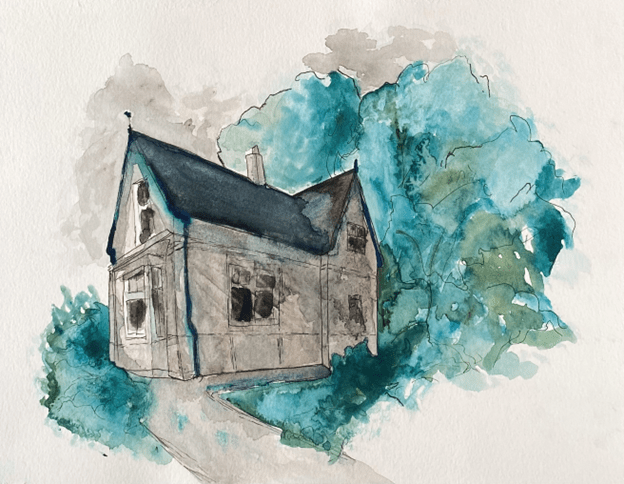
Ava Lindsay, Class of 2027, has always loved doing art. While she is planning on making Astronomy her major, she wants to make 3D Animation her minor. She was an editor and contributor to a Literary Magazine for three years of Cyber High School at home (10th grade to 12th grade), and is willing to join Lycoming College’s Literary Journal.
Testosterone by Aiden Brown
The butterfly’s broken
wings fall to the ground, landing
in my pile of oily compost—waiting
to be repurposed.
I bet the creature wishes,
in its last moments that it could crawl
into a cocoon again, and save itself.
I bury the Monarch and watch as the soil stirs red.
New hair follicles bloom
in place of the silky estrogen
garden on my stomach. My throat aches
at the thought of digging up the growth—or maybe
that’s just my larynx stretching.
Medusa by Sunshine Offerman
i want these hot truths to slither
out of my mouth, with
scales that shine like suns,
and i want people to clamber
and scramble to grab hold of them
and stuff them in their pockets.
i want to look up to a sea of myself,
gripping my snake truths like offerings,
grasping to contain them while they
slide into their clumsy souls.
and i want to smile and weep
and watch the sea smile
and weep as tears fill their gaping
and truth-speaking mouths.
9 to 5 by Thatcher Gunnells
Over two months of “hard work” have finally
come to an end. The rest of the cast embrace one another,
a python’s grip sapping the last bits of strength from their
bodies. Adrenaline carries them to the wings. I remain frozen,
waiting for the all-too-familiar muscle ache and shredding
of my vocal cords to do the same, but it never does. Instead,
I stand alone before an unrecognizable crowd, golden
halogens spotlight my every flaw.
“You stick out too much.”
The usual degrading voice in my head isn’t just mine anymore.
I was a fool to believe the excuses I was told. Apologies
from ensemble members ricochet off my ears;
they have nothing to be sorry for. They didn’t ask “who?”
when I was sitting on my backstage throne, waiting for a cue.
The post-show adrenaline rush never hits me. The last time
I felt it, I was staring at a cast list with my name written
beside “Josh Newstead”. I had known that I couldn’t
truly be “One of the Boys,” I would never have auditioned,
or stuck through the nights of not being needed. But I’m no quitter.
Not anymore. Either way, I’ll stick to the script I was given.
Exit stage right
Elimsport by Chase Bower
A tepid breeze brushed stalks
Of wheat. My car sputtered as hills
Rolled by, alvoces of mountain walks
Carved in fields, grass like dollar bills.
A diesel trail rose from the exhaust
before I parked. A single street
Hosted a market and fences of lost
Livestock and signs: “2 miles, meat,
7 miles, Williamsport.” Not a soul
Roamed the village, tucked inside
Their homesteads, as I stole
A glance at a horse’s lustrous hide.
Grain passed by as I headed home.
My tank nearly empty, I stomped the pedal
as the breeze carried dandelion seeds, blown
and landing in the shade of another’s petal.
My Jouissance by Vijai Budhun
My jouissance came from you
like a farmer feeding his cattle.
The cattle consume.
The farmer consumes the cattle.
The Science of Never Letting Go Of You by Hannah Lee Defrates
Characters:
Poppy- (female-presenting, 20’s) perfectionist; legal guardian of her sister Violet and their friend, Chrys
Willow- (female-presenting, 20’s) young at heart, but not without her trauma; runs a daycare while being the legal guardian of her teenage brother, Daff
Time: Around 3:00-ish on a weekday in a year undefined.
Location: The living room of Poppy’s apartment in the Order of Contagion, an aesthetically plague-core society that exists contained within a high-rise.
(At rise: The interior of POPPY’s apartment. It’s a simple, fourth floor dwelling which opens into a living room with a kitchen to one side. The walls and furnishings are muted colors like mauve and gray, simple yet somehow just right. POPPY enters, dressed in a cloak and plague doctor mask. She takes off the mask and cloak, hanging them on a hook on the wall. Underneath, she is dressed business casual, and her hair is in a tight updo. She is also wearing lipstick as red as, well…a certain flower. She kicks off her heels before lining them up neatly beside the door. She turns to a mirror on the wall, fixing her makeup, and smoothing out any flyaways in her hair or wrinkles in her outfit. Then suddenly, she spots motion behind her.)
POPPY: When were you going to say hi?
(WILLOW looks up from where she is lying, face-down on POPPY’s couch.)
WILLOW: Hi.
POPPY: What are you doing?
WILLOW: Oh you know, just lying here, contemplating the eventual inevitable end of existence and the pain of eternal suffering.
POPPY: In my apartment?
WILLOW: Where else?
POPPY: Rough day?
WILLOW: (groaning) Uuuuuuuuuugh!
POPPY: Want to talk about it?
WILLOW: Obviously!
POPPY: Okay. You want tea?
(POPPY crosses into the kitchen.)
WILLOW: Bleh.
POPPY: Juice box?
WILLOW: Ya.
POPPY: Is Violet here?
WILLOW: Nope. Just me.
POPPY: ‘Kay!
WILLOW: So how was your day?
POPPY: Same old. (Then, suddenly remembering.) Oh, hey. I think my suspicions are confirmed.
WILLOW: Oh?
POPPY: Yeah. That creep, Anthos is definitely hitting on me.
WILLOW: Ew! The one with the staring problem? Tell him to butt out.
POPPY: It’s a sad attempt really. (Tiny pause.) I think I’ve made it quite clear how I feel.
(Laughs in lesbian)
WILLOW: I’ll fight him.
POPPY: I’ve got it under control. It’s just annoying.
(POPPY returns with two teacups, one with tea for herself, and an identical one clearly filled with juice, with a yellow plastic straw poking out of it. POPPY passes that cup to WILLOW.)
WILLOW: Classy.
POPPY: So what’s going on?
WILLOW: (listlessly) Welcome back to Willow’s Daycare Adventures. Okay. So today…there was this kid—
POPPY: “This kid”?
WILLOW: I feel like I should keep names confidential.
POPPY: That’s fair. So “this kid” came over and then…?
WILLOW: Little kid came in and when she took off her mask…big bruise on the side of her face.
POPPY: Oh my gosh.
WILLOW: So you know what I thought.
POPPY: Clearly.
(Small pause.)
WILLOW: But I had an apartment full of kids, so…When Daff came home for lunch, I got him to watch them for a second, and I took the kid aside. And I was like, “Hey friend, is everything okay?” And she was like, “Yeah. Am I in trouble?” And I was like, “No, of course not! But I see you have an ouchie on your face. How’d that happen, my friend?” And she proceeded to tell me a whole story about tripping while playing The Floor is Lava with her brother. Even showed me a scrape on her knee from where she fell. And then she laughed, like “Guess I got burned up by the lava. Teehee! Can I go play blocks?”
(Beat. WILLOW sighs.)
POPPY: Gotcha. Well, it wasn’t… what you thought.
WILLOW: I overreacted.
POPPY: You didn’t. That’s a serious concern.
WILLOW: I know, and it got me thinking…I don’t know what to do if something like that does happen. Seriously, how many years have I been doing this? And I’m just thinking about this now! I mean, I—
POPPY: Hey…
WILLOW: I see these kids all day but I don’t know what happens when they go home. And if some parent is coming home drunk, yelling and…
POPPY: Willow.
WILLOW: I’m sorry—
POPPY: You don’t have to—
WILLOW: But what do I do in that situation? I can’t do nothing. I can’t just…So what would I do? Snitch on the parent? I don’t know what would happen in that situation. Would they get washed? And if that is what happens, then the kid is traumatized. And potentially orphaned. And then is it my responsibility to raise the kid? I mean, it would technically be my fault. Everyone would blame me.
POPPY: Hold on.
WILLOW: And Chrys and Daff would never look at me the same way again. Snitches get stiches.
POPPY: None of that is going to happen.
WILLOW: It could.
POPPY: I know you’re worried, but you’re getting way ahead of yourself here. This is all hypothetical. But for the record, I don’t think Daff would ever judge you for doing what you thought was best if you thought it would help someone.
WILLOW: I don’t know that.
POPPY: I do.
WILLOW: I promised myself his childhood wouldn’t be filled with stupid traumatic crap…
POPPY: Willow.
WILLOW: What?
POPPY: Deep breath.
WILLOW: I just… This isn’t just some meaningless task.
POPPY: I know—
WILLOW: And that’s no shade to you or anyone else—
POPPY: None taken.
WILLOW: It’s just, I’m responsible for a bunch of little lives. Gotta make sure they don’t die, you know? And it’s not like it was just thrust onto me. No. I chose this. The daycare was my idea. So if I mess up, it’s my fault. And then there’s Daff…And I just…I don’t wanna be the reason any of these kids can’t sleep at night.
POPPY: I get it. That’s a lot.
WILLOW: It’s not anything more than everyone else has to deal with.
POPPY: Are you kidding me? That’s a lot. And for what it’s worth, you’re doing a really great job.
WILLOW: I guess.
(POPPY gets up and starts to clear away the cups.)
POPPY: And you know, if you ever need anything…
WILLOW: Yeah.
(POPPY puts the cups in the kitchen and returns to the living room.)
POPPY: You okay?
WILLOW: Yeah. I’ll be fine. But sometimes I wish I had someone to like…hold my hand…or something. (Pause. POPPY grasps the air, as if she were reaching out to grab someone’s hand. She smiles slightly, holding a soft fist.) What are you doing?
POPPY: I’m holding your hand.
WILLOW: You’re holding nothing.
POPPY: Correction. I’m holding air.
WILLOW: Ok still. If you’re holding air, you can’t be holding me.
POPPY: I am holding air. But. The air is touching the couch, which is touching the pillow, which is touching your hand. So, I am holding you by the transitive property.
WILLOW: Oh fancy. What is that science?
POPPY: Math I think.
WILLOW: Same thing!
POPPY: If you say so.
WILLOW: Okay, so wait. If that tramalamadingdong thing—
POPPY: Transitive property?
WILLOW: Yeah that. If it’s real…
POPPY: And it is.
WILLOW: …then you’re kinda always holding my hand, aren’t you? Even when we’re not in the same room.
POPPY: Yeah. That’s kinda the point.
WILLOW: Wow.
(WILLOW grabs the air and holds it as POPPY had before. POPPY reaches back. Beat. POPPY joins WILLOW on the couch. After a long moment, WILLOW smirks.)
POPPY: What?
WILLOW: (teasing) You’ve really done it now, you know.
POPPY: What?
WILLOW: You’ve made it mathematically impossible to ever get away from you.
POPPY: I know, what a tragedy.
(WILLOW snuggles closer to POPPY.)
WILLOW: The worst.
(They sit there for a bit, afterwhich POPPY puts her hand on WILLOW’s arm.)
POPPY: Hey, if something bad ever does happen, you know you don’t have to handle it by yourself, right?
WILLOW: Okay self-help book.
POPPY: Wow. Okay.
WILLOW: No I get it. You’re there.
POPPY: I’m just saying, if there’s ever an issue where we absolutely have to get the Officials involved, I’ll do it. Let everyone blame me. Chrys already hates me, so it’s not like much will change.
WILLOW: She doesn’t hate you.
POPPY: Oh yeah? It’s not like she’s very good at hiding it. I can’t be the only one that sees it.
WILLOW: She’s a teenager.
POPPY: So’s Violet, but she doesn’t act like she wants me to spontaneously combust.
WILLOW: That’s because Violet is an angel.
POPPY: Mmhm. Sure. So then what about Daff? Does he get all moody?
WILLOW: Sometimes.
POPPY: (Sighing) I think you might’ve been right.
WILLOW: Yeah I was! (Blink blink) About what?
POPPY: Saying Chrys and I just don’t get along.
WILLOW: When did I say that?
POPPY: When I first decided to take her in, you said—
WILLOW: Pshh! What did I know? I think you’re doing a great job.
POPPY: Did I do something wrong?
WILLOW: Bah!
POPPY: I don’t yell, I don’t…I don’t know. She looks at me like I’m her wicked stepmother.
WILLOW: Ooof.
POPPY: Yeah.
WILLOW: Well, at least you’re the fairest of them all. (POPPY snorts.) Hey. (She holds the air.) Transitive property.
POPPY: Yeah.
(The two women sit together for a long time, holding hands for real… and even when they eventually let go, they never really do.)
[End of Play]
Twelve, Thirteen by Ella Rossman
January 3rd, 2016 was the last day of Christmas break, so I thought it in rather poor taste that anyone would make a joke about Aidan Fowler dying. The text I had received from my good friend Kelly was a screenshot of Facebook messages saying “RIP Aidan” with no other context. What a terrible thing to say. That could really upset his parents, don’t they know that? I did not reply and went about my Sunday like every other: going to church, doing chores, and relaxing with YouTube. Yet, the prospect that he could actually be gone lingered in my mind all day. At dinner, a knot formed in my stomach and I knew, suddenly and certainly, that it was never a joke. My mom drove up the road to check on his family. While I waited for her, I excused myself to the bathroom and screamed into the emptiness. She came back in the door five minutes later, sobbing hysterically. Yes, the cancer won, with enough mercy to kill him quietly in his sleep. Even now I do not know the reason, but that night, I did not cry.
I already knew he was going to die. He had been sick since the beginning of sixth grade, and we were halfway through seventh grade. My parents told me three weeks before Christmas that his parents were taking him off the treatment plan, because nothing, no matter how expensive it was, no matter how hard the doctors tried, was working. He experienced pain worse than I could fathom every day. I sobbed that night, more out of frustration than grief. I didn’t understand. They had to try harder to save him. Hope couldn’t be gone. Humanity always found hope and fought, no matter the odds—one of our finest traits. Didn’t his parents love him? Why weren’t they trying? My parents told me to keep praying, which I hadn’t been doing as often. I had begun to doubt my faith. God would never let a child die, a child that loved Him so much. God loves His children. God loved Aidan, so he would save him. Right?
They did not cancel school the next day. I now know that they couldn’t. Us kids had to be distracted, and truthfully, Aidan was one out of about 900. My best friend at the time, Jordan, did not speak to me on the way to school. Our silences echoed back at each other over the low rumble of the engine and the whispers in the back among high schoolers who did not know who he was. My homeroom was quiet, unnaturally so for seventh graders. Over the announcements the principal’s robotic voice took the stage, saying that extra counselors would be available for the next few weeks. We understand how hard this will be on some of you. Aidan was a loved member of Central Mountain Middle School. Please reach out to the counselors if you need them. English class was hell. No one would talk, not even me, the Hermione of every class I was ever in. My teacher had the most awful chipper attitude to compensate for the lack of noise. She refused to acknowledge that anything happened, which infuriated me. She pretended he never existed. We moved on in our lesson about grammar, but all I could focus on was her: her curly dyed blond hair and perfectly made-up face, her stupid shiny shoes and huge dangling earrings, and of course that smile that seemed almost dystopian in its forced fakeness.
Two of my other friends, Haley and Maggie, went to counseling during lunch. I went with them for emotional support—ironic, given that I needed it more than they did. I had not yet cried, which I supposed made me strong enough to handle things for other people as well as myself. Jordan did not go. She didn’t know him well enough, she reasoned. Fair enough, I thought. She would have hated it anyway. The counselors were saccharine in their words, so gentle and condescending. It was good for my friends, but I sat in silence at the table, rubbing Maggie’s back occasionally. One of them asked me if I knew him.
“I lived on the same street as him,” I said. “We grew up together. But I’m here for them.”
The counselor was surprised, and I felt a faint satisfaction, a Band-Aid over a gaping hole, that I was strong enough to not cry when my friends needed me.
“Are you okay?” the counselor asked me. “You can talk too, if you want.”
I was about to laugh at the stupidity of that question. Are you okay? It was like asking someone who’s been shot, “Where does it hurt?” I wanted desperately to laugh, but it seemed to get stuck in my throat. Everywhere. Everywhere hurts. I nodded and avoided talking for the rest of the period. ‘My throat hurts’, I wrote down on a sticky note, and it was true, it hurt terribly from the lump in it that would not go away.
The following day, Tuesday, does not exist in my memory. (In truth, I don’t really remember much of that month. I think I tried to block most of it out.) Wednesday, however, is cemented in my mind as “funeral day,” the first funeral that I was old enough to really understand. Aidan’s family held an open-casket ceremony in the middle school auditorium. I sat at the front with Haley and Maggie. Jordan did not come. I searched and searched but she was not there. I realized in that moment that she did not care about me as I cared about her, and I began to cry. The
service had not even started yet. I had just lost one friend, and it seemed I was already losing another. I cried three days’ worth of tears during the hour-long ceremony, only stopping to scowl when the choir sang out of key.
His body looked…off. He was too pale. Even with cancer he had never lost his rosy cheeks. I missed his nearly white hair that always stuck straight out from his head. He was not wearing his treasured red Phillies baseball cap in the coffin, which seemed abhorrent to me. My parents wept openly next to me, holding his folded hands. I could not bring myself to touch him. I did not want to feel death on my skin; I did not want my body to know what my mind did. I have regretted that choice from the moment I walked away from the coffin. Fairly recently, another classmate of mine died, and I astonished myself with my own weakness, for I was again unable to touch the hands of the dead.
I was almost fifteen when he would have turned fourteen. Exactly 11 months separated us in age. He relished that catch-up time with me when we were little. On August 19th, 2017, I visited his grave to wish him a happy birthday. I sat in the sun at his slate gray stone, telling him about everything that had happened in the time he was gone. I stayed for an hour. I confessed my secrets, I told him that things had changed for me, and that I was excited for high school, though it wouldn’t be the same without him. As I talked, I could feel the sun burning the back of my neck and the tips of my ears to a crisp. The symbol of my shame that I attempted to ignore was almost comical in its physical effects. I wanted to make up for lost time, but of course it did not work. Eventually guilt and sunburn consumed me, and I went home. For the first time ever, I wanted to die, perhaps thinking I could trade his soul for mine. I cried as I never had before, almost an hour of heaving tears on the couch, wishing I had been a better friend. My mom told me not to hold the tears in—
I had been holding them inside for long enough. It had been a year and nine months since he died. I finally, finally, found myself moving forward.
My favorite memory with him takes place on a snowy morning half a lifetime ago. 2012—the year we thought the world would end. School had been canceled, a blessed day for us kids. His mom had to work, so she dropped him and his sister off knowing my mother would take excellent care of them. She had already dressed him up in his green and black snow gear, with black mittens and a matching beanie, so we were ready to go out in the perfect and pure snow when he arrived. They were the kind of flakes that stuck together, clumping into spheres the perfect size for our tiny hands. I do not remember which of us started our snowball revolution, but I won. I sat on top of his chest, smashing a snowball into his reddened face, smug and victorious. My mother has the pictures to prove it. That perfect snow lasted a day and melted into obscurity. No winter has matched it since.
I am twenty years old now. I try to talk to his mom as often as I can, especially since I have started college. She once confided in me her deepest fear—that people would forget about Aidan. She doesn’t have to worry about that. I think about him every day. I remember how he wanted to be the Phillie Phanatic for at least six years. I remember playing Super Mario 64 with him in homeroom and handing him my DS for the difficult parts. I remember his birthday parties, how we would mess around in his swimming pool since my family didn’t have one. I remember his favorite color was green, complementary to my favorite color red. I remember how he was an excellent writer, reading his essay at our fifth-grade graduation. I remember how he laughed, how he was so energetic, how he always took care of his sister. I often wonder who he would have become, had he lived. I wonder who I would have become, too. We were only children, after all: he was only twelve, and I, thirteen.
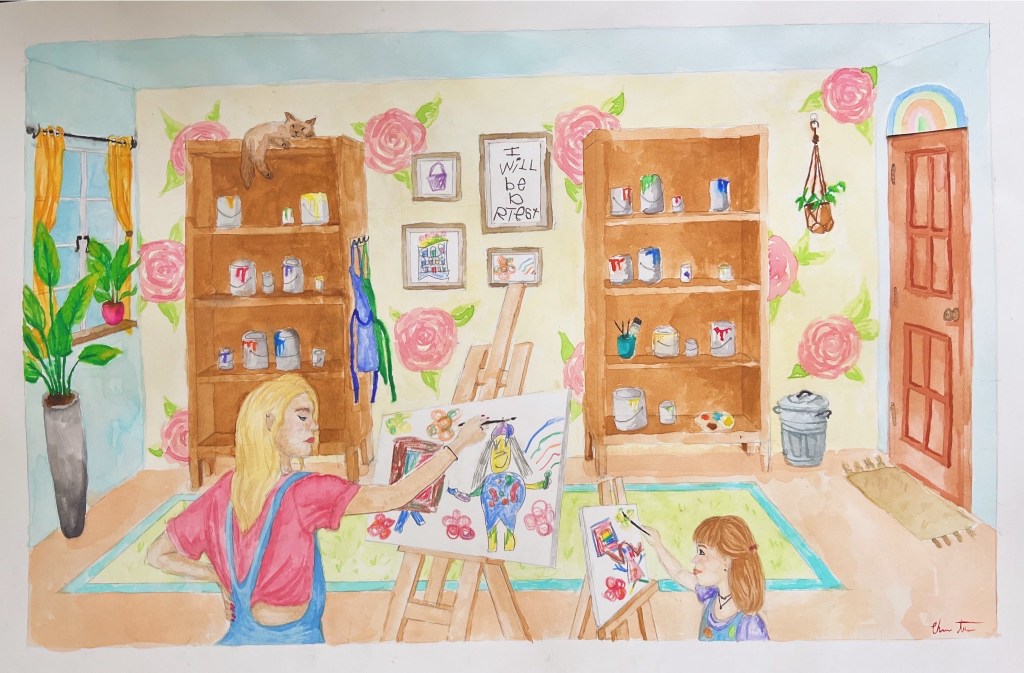
I WILL BE A RTEST by Chloe Troup
7:30pm by Aiden Brown
I wasted a lot of my time wishing
for someone to spend my favorite time with.
Pink painted skies, made for lazy kissing
as the sun fades, promoted the soul myth.
Two souls: without one mind interwoven.
There was nothing but gritty bodies, bare.
The reality of gentle lovin’
cascaded into my lungs and wept there.
Real partners float together when the air
turns rotten, sulfur lingers, and breaths thin.
They’re more than hands that wander, but you’re fair.
Sour fears sopped with intimacy grin,
I hold your hand, without attack. I’m glad you’re clutching
me as the sky turns dark red.
Table of Contents
The Wonders in the Shadows
J. R. Valdez
The sky was still a bit gray from the drizzling rain that stained the car windows with the sky’s tears, racing each other down the glass as they collected and dried at the bottom. My surroundings were dreary and provided me no joy. Why would there be a need for such weather? In the absence of the sun’s rays, the temperature lowered and the atmosphere felt bitter. Why should I look up to admire such a grayness? The world felt mirthless, melancholy, and monotone. It should be no different than my phone screen, black text against an undeniably impure white. They both lack the color everyone yearns to obtain at least once in the day.
“Come on, Jules,” my younger sister whined, “you’re always on your phone! Talk to me!”
Perhaps that was true. I was on my phone constantly. But, unlike most teenagers, I was not playing a game or on social media, pretending that those people are actually my friends. I was writing books. I was being productive. I believed that because I was doing something that could be beneficial in the long run, career-wise, that it excused me from being social with my family. Writing also always gave me relief from stress and social anxiety. And on days like this where there is no laughter and a cloud of toxic nothingness suffocating the air, I let my head fill itself with color and creativity instead of relying on my surroundings to do so. Writing always lifted my spirit and numbed the lingering pain to which I now carry for inspiration.
“I’m writing, Selene. Cut it out,” I told her, not even removing my eyes from the screen. “Chapter twenty-two! Let’s do this!”
The sassy seven-year-old rolled her eyes back into her skull and slapped her curls into my face to which I completely ignored and continued tapping at my screen. She huffed exaggeratedly and rammed her head into the black leather seat behind her, folding her arms over her chest in annoyance.
Upon hearing no response, Adrien allowed tears to leave his eyes, cursing the stars that marked the day he’d lost his mother. A loud clap of thunder startled the boy to the ground, sobbing hysterically as he was now holding his knees to his chest in the fetal position.
“M-Mom…”
Gabriel rushed out and scooped his son into his arms, holding him closely. “Adrien…”
“W-Why…” Adrien sobbed, “why didn’t you tell me that mom was dead?”
“We don’t know that, son.” Gabriel brought him inside and wrapped him in a towel, drying him from the rain. “She’s just… disappeared.”
Now, what? That explains more about Adrien’s past, but how do I transition out of the nightmare? Should this be the end of the twenty first chapter instead of the beginning of the twenty second? No, the last chapter is already published and is long enough as it is. Why is this so difficult? Well, I guess, even writing can be stressful if you’re stumped and you haven’t updated in six days. I shall feel the wrath of eighty thousand Miraculers (members of the Miraculous Ladybug fandom) with pitchforks and torches if I don’t publish another chapter of Emotional Support soon. I threw myself back into the world of imagination, trying to grasp any ideas for my current chapter—nada. Okay, I give up.
I tore my eyes from my phone and fixed outside the car window. It had seemingly stopped raining and the darkened clouds seemed to slowly diminish. My anime-faced phone dropped onto my lap as I seemed to catch the colorful sight of the remaining water reflecting the peeking sun’s light.
“Wow.” I gaped. “A rainbow!”
“A rainbow?”
“Where? Juliette, where?”
“I want to see it!”
My three sisters went wild, their voices merging in their excitement as they all searched for the same sight. I said nothing as I only raised my index finger to point in the correct direction. As soon as they had seen it, they fell silent, and once we hit a stoplight, my parents took the opportunity to admire it as well. It wasn’t a full, vivid rainbow that you’d find in a cartoon or something. But, it was a short string, this small burst of color and hope, kindling out from within the clouds.
However, it wasn’t long before the rainbow disappeared, without leaving a kind trace. My eyelids dropped halfway as my mesmerization was disrupted with the once again dark colors that surrounded me. However, this time, it was not caused by clouds, aggravated by one another, but by the clustered ravens ripping through the air and over our car. They flew with such togetherness and determination to which I had felt honored to have witnessed it. Everyone within the vehicle was silent as the scene unfolded before them.
Who knew that there was even beauty within the darkness? That inspiration could fester beneath black wings? It is not only the color or sight in which creativity blossoms, it is also the feelings it evokes, and the memories you cherish.
I looked at my sisters with stars in my eyes. “Woah, those birds were gorgeous, weren’t they?”
The second youngest, Ella, raised her head from her view fixed on her iPad, tucking her blonde strands behind her ears. “What birds?”
“The black birds!” Aliyah, the second oldest, answered, pointing out the rear window as the ravens shrank in the distance. “You totally just missed them!”
In the last mere two minutes of my life of fifteen years, I sat in a car with the people I love, and witnessed two of nature’s natural beauties. All of a sudden, I felt a surge of energy, a willingness to write the next scene of chapter twenty-two. I can’t let the darkness just devour Adrien; I’ll use it to our advantage instead. This won’t be a scene of dread and depression; it will be of comfort and love. Perfect.
I do know one thing for certain: If I hadn’t put my phone down when I had, I might have missed a chance to witness the wonder in the shadows.
Juliette Valdez is a sophomore at Adelphi University. As a writer, she goes by J.R. Valdez. At age twelve, Juliette discovered writing was her passion and that she was going to become a famous novelist and poet. By age thirteen, she sent her first book, Behind the Mask to an editor and proceeded to get it self-published on Amazon Kindle. In tenth grade, she had a poem published in Jericho Senior High School’s 2019 Pegasus, book of poetry. The poem was titled “Pain Marks My Existence” on page 101. To this day, Juliette has continued to write novels, short stories, and poetry, some of which are published on Wattpad. One of the more popular books is titled, “Feels Like Home.” Juliette will continue to write with a true love for the craft as long as she lives.

