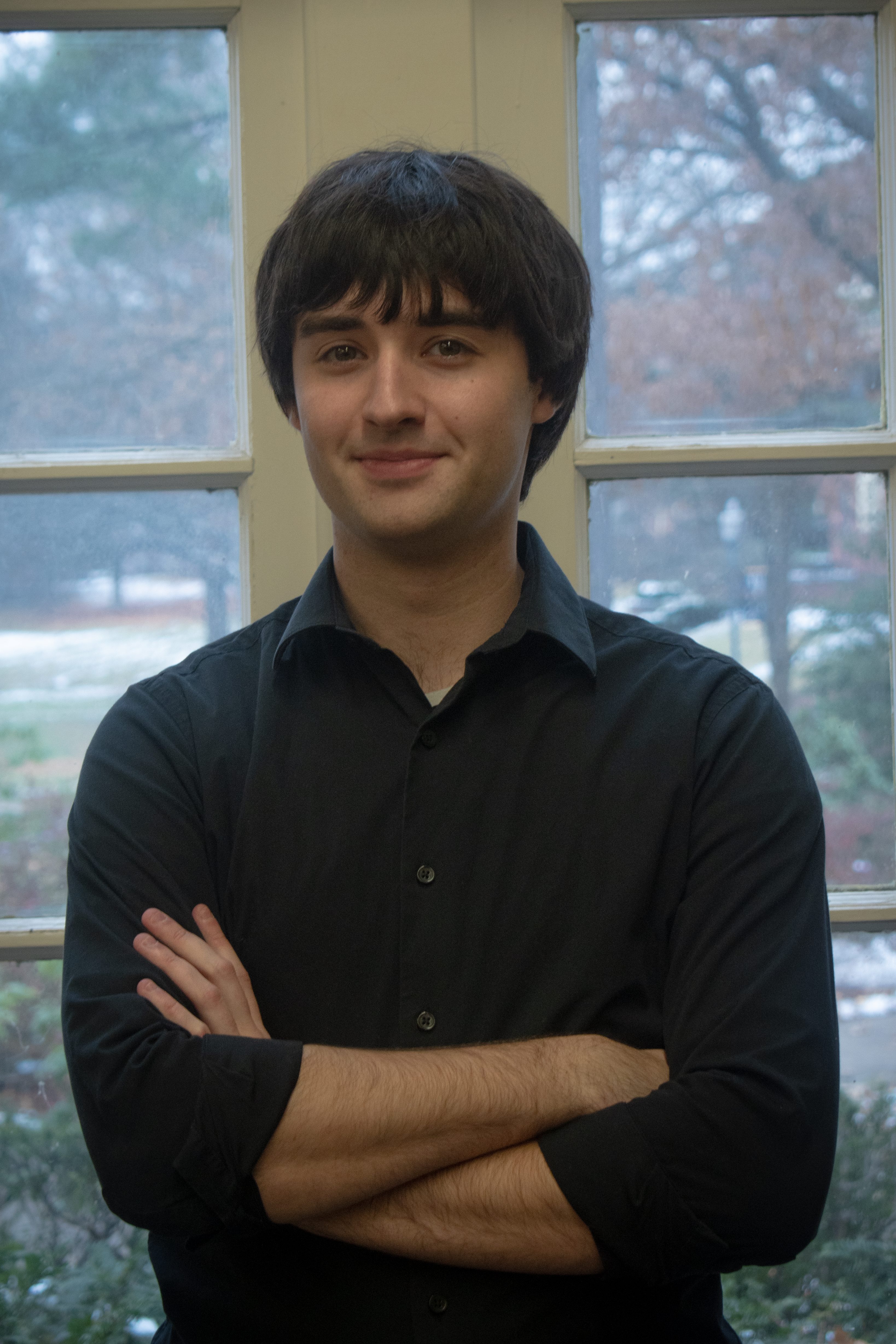
Chase Bower (he/him) is the managing editor of the Tributary. At Lycoming College, he studies Communication & Media Studies and Creative Writing. When he’s not managing the Tributary, he’s likely singing or working on a table-top game. He primarily writes poetry, but wanted to submit a piece of short fiction to diversify the edition, as well as an interview with Lycoming alumni Cassandra Mainiero who used her experience submitting to the Tributary in her career!
Interview w/ Cass Mainiero
Could you give a brief introduction, for those not familiar with you?
Degree: English-Creative Writing, Poetry from Lycoming College (2013)
Employment: Secretary/Purchasing Agent at the Department of Veteran Affairs.
Some interesting things: Graduated from Vermont College of Fine Arts or VCFA (2016), taught English in Japan (2018-19), worked at Tuttle Publishing, and published poems in Black Fox Literary Magazine & Bucknell’s West Branch Digital Magazine.
What are some of your favorite genres? What do you find yourself writing and reading the most?
I like fiction and poetry, but my favorite genre is memoir. My current favorites include: “Roughhouse Friday” by Jaed Coffin and “Solito” by Javier Zamor.
At Lyco and VCFA, I liked novelty and was interested in writing and reading about various new subjects. My poems never had a consistent theme. However, during the COVID pandemic, I did a VCFA postgraduate semester with Tomás Q. Morín, who pointed out that many of my poems were love poems. It was eye-opening and a game changer. I can’t unsee it.
Currently, I’m working on a collection of poems about memory, women, dementia, and generational trauma / illness. The poems are sprinting onto the page in a way they never did. It’s been hard to keep up. It’s exciting!
How did you start creative writing? Do you find that working with writing impacts your own writing, either positively or negatively?
My interest in writing gained momentum after I read “The Armful” by Robert Frost, which I stumbled upon while avoiding required reading in middle school. Something about the poem’s illustration of overwhelm and longing as well as its recognition of one’s limitations resonated with me, so I copied it to remember it.
For several years, that’s all I did: I’d hand copy poems that I enjoyed into a journal. It was for me. No one else. Eventually, though, I tried to mimic or respond to those poems in my own work. This practice made me realize that A) It’s harder to rhyme than I imagined and B) I had a lot of opinions and feelings that I didn’t realize before.
That self-awareness was liberating. I gave me strength, too. I liked seeing if my work resonated with anyone or inspired more questions. It was especially nice if my poems sparked debate or discussion. What a compliment!
What did you submit to the Tributary?
My first submission to The Tributary was a small poem about strawberry picking. The other two submissions were written in my poetry classes at Lyco.
One was “Daguerreotype.” It was a prose piece about a women losing her eyesight and trying to memorize her husband’s face. The title refers to an old photography style with black borders, which makes it look like darkness is encroaching on the image. Sascha suggested the title, and it perfectly suited the piece. It taught me how a good title can lift a poem to that next level.
The other was “In Our Zoetrope.” That poem was written in Form and Theory, a senior class at Lycoming, where students practice different poetic forms like sestina, villanelle, pantoums, etc. “In Our Zoetrope” is a sonnet that illustrates the disconnection between lovers. I was happy with the result. I wouldn’t say I wrote my finest work in Form and Theory, but I liked this one and the class exposed me to new writers and made me more appreciative of the craft.
How did faculty support your writing? What was your introduction to the Tributary, and what did having it accepted feel like?
Before Lycoming, I had this vague idea that constructive criticism was like some scathing and scalding writer rite of passage. I was warned to steel myself.
However, I had a positive experience at Lyco. The creative writing workshops were formatted in the same way as my MFA workshops: weekly submissions, class discussions and group feedback. I thought that all colleges followed such a format, but I was surprised when I met MFA students who never had that experience and were panicking before our workshops. I felt more prepared.
In my poetry workshops, Sascha didn’t coddle. Rather, he encouraged students to be discerning. He urged us to look for what is and isn’t working in a submission. This helped to identify our own personal style and individual strengths. It taught us to be better readers/listeners, too. If an idea or image didn’t work, we were expected to explain why. He wanted us to be good students as well as independent, lifelong learners. So, yes, Sascha shared resources, tools, and feedback. He also urged us to work hard, listen, and stay open-minded and curious—even after graduation.
That’s the same attitude I saw in other faculty members.
Of course, there were awful drafts and tough feedback that made you want to hide in a hole, but critiques do come with the territory. I never felt that some feedback or lesson was so disheartening that I didn’t want to return. I felt supported.
Whenever I got something accepted by The Tributary, I felt more motivated. The Tributary is managed by perceptive editors and features talented, upcoming writers. I felt honored to be part of such a community.
Did you feel supported by a community of creative writers on campus? Did students seem interested in creative writing?
Yes. Part of the advantage of studying at Lycoming was its small class sizes. Smaller classes meant more individual feedback. It also meant we saw a lot of the same people. For me, that familiarity helped me identify another student’s tendencies or resurfacing themes. It cultivated an awareness of each other’s blind spots, too. It was always rewarding to watch each other grow as writers.
The classes welcomed a variety of majors as well. We had not only philosophy and literature majors, but theater, science, and music majors. That diversity added more flavor to our classes and shed insight that made our writing stronger. I remember being completely endeared by Ethan Sellers. He wrote a beautifully heartbreaking piece about his dog and was so eager to learn more about poetry—even though he was a biology major and planned to be a doctor. His joy brought joy.
Have you read anything recently that you really enjoyed? If not, is there something you read at Lyco you remember well?
Recently, I read a personal essay by Chimamanda Ngozi Adichie in Vogue. It was a gorgeous essay about her first love and resulted in buying her book, Dream Count.
In terms of poetry, I’m currently obsessed with Lisa Olstein, Naomi Shihab Nye, and Mosab Abu Toha. Olstein’s “Horse” features short line breaks that result in a cadence, where the poem picks up speed as you’re reading. By its end, it feels like the speaker is the horse or you’ve been riding a horse. I’m in love with it.
Something at Lyco? Hmm. We read a lot of work at Lycoming. I remember taking a literature class with Dr. Carol Moses on 18th-centuty literature and being completely disenfranchised by romance poets. I also remember being uninterested in T.S. Eliot,
adoring Theordore Roethke, feeling seen in “The Fish” by Elizabeth Bishop, loving Emily Dickinson, and ranting about Troilus in an essay about Troilus and Cressida.
One that continues to stick with me, though, was not a famous poem, but a poem by Kyle Clemens, a fellow student in a poetry workshop. In one of his works, Kyle wrote that even a neon light at a gas station can become a source of comfort in the dark. I thought about that idea a lot in Japan, where I would bike home at night and pass all these fluorescent vending machines. I still think about it if I’m driving alone on some dark, country road.
To those aspiring towards a career in writing, be it publishing or writing or something in the area, what is something you wish you were told (or good advice you were told)?
Cut the bow.
At Lyco, all my poems had a “bow.” The “bow” is a short summary or overarching lesson that I tried to spoon-feed in the last few lines, nice and neat. I think it was a habit that developed from a vague, misguided idea that poetry is meant to unveil some hidden message or epiphany. Really, though, I was being a stage-mom. I didn’t trust my own writing.
Also: Consider the line. In the early years, all my poems featured stanzas that were like big bricks of text, where all the lines were synchronized and broken into similar lengths. My poems looked beautifully rigid and visually insane.
Then, during my MFA, I studied enjambment and it opened a whole new direction. I learned that line breaks are unspoken powerhouses. They add depth and layers to a work, inviting complexity, where silence does as much heavy lifting as the words.
I think that shift was fostered by great mentors. It also just came from finally giving myself permission to be messy. That’s why I would advise to any young writer: don’t forget that good writing requires us to play. Break a line. Give your speaker agency. Re-arrange the stanzas. Add dialogue. Lean into that alliteration. Change the punctuation. Read. Rewrite. Delete. See what happens.
…
I can’t thank Cass enough for taking the time to delve into her experience with us. Now, this is a piece of short fiction I’ve been tweaking for years and feel alright making public. That’s sort of the point of The Tributary, huh?
On Green Dolphin Street
Jeremy swept his tiled floor, kicking up dust hanging in the kitchen air like constellations swirling down from a mobile. His old shelves clung desperately to the wall, the chipped eggshell paint covered the countertop, his University of Chicago diploma, the picture of his father standing in a silver frame. Beside it, a caricature depicted his family with cartoon proportions; Jeremy remembered the static feeling of his old neon-yellow shirt and what not wearing glasses felt like. His calendar hung from a thin string, depicting the chores of today: two meetings with corporate, then a visit to his father.
A fresh stack of paper sat on the table, registration for his father’s retirement home. A crinkled paper sat next to it. “Alzheimer’s: Positive.” Jeremy was far from surprised. His father’s test went exactly how he expected, a week ago. “Who is the president?” they asked.
“Well, that’s… uh, that’s… that’s Carter?” Christ. Not even Bush? Clinton?
Eggs crackled, bacon fried, toast popped, and his fingers rustled through a splotch of grey in a sea of matted brunette hair, weighing down on his head, reflecting the morning light. He snapped back to his routine and checked on his breakfast, yolks firm and bacon charred, but his eyes darted between the stove and the black trumpet case sitting by the door. The egg whites were solid, frayed at the edges, and the underside sizzled gold when he took them off the pan. Butter melted fast as Jeremy took it down fast, tasting little and caring less just like his father, before an alarm shot from his phone, and as he rose from his seat, he noticed the alarm song.
“On Green Dolphin Street.” Miles Davis, 1958.
Jeremy’s thin fingers opened the three golden clamps on his father’s trumpet case, and from the dark velvet shone his father’s instrument. He blinked on beat and connected the mouthpiece. Jeremy’s lips pursed, his eyes closed, and, like buttering toast, he entered smoothly alongside Miles, piano keys and trumpet whistles spiraling around each other, mixing like cumin and oregano, flowing into cerulean air and whisking Jeremy with them, each note another ingredient to a 2-part meal, seasoned and flavored, as white softness floated lowered him, and the whistle slowed and slowed, and the piano’s fluttering melody glided, and his feet touched the ground again.
His inner rhythm lessened, and a mounted clock’s tick filled in. He clutched his trumpet as if it might fly away, once cold metal and now as warm as Jeremy. His expression glowed with stardust, like a gentle orbit, and his blood calmed as he sighed. Dad would’ve loved that. He would’ve, had he known the one playing was his son. As the months passed since the diagnosis, the chances of that approached zero.
On an overcast Sunday, 40 minutes fresh from church, Jeremy entered room 222 of the Daffodil Wing. His bangs grew matted; in shifting moments, he shivered, then felt the sweat cling to his button-up. His palms shook, and he blew cold breath onto the one not holding his trumpet case.
“Hi.” He peered over his father lying at a slight incline in his hospital cot, covered in his white linen blanket. From deep down in the wrinkles of his forehead, Jeremy could almost see turgid thoughts swirling. A young nurse ambled into his room, leaning on a rickety food cart.
She scratched her nose. “You must be William’s son, I can tell. He’s just waking up, now.” On her cart, a foam cup of soda water with brittle ice cubes sat next to fat-free vanilla pudding, whole grain pancakes, sugar free syrup, a plastic fork, and a Dixie cup of various pills. His weak and beady eyes, then his thin lips, struggled open.
“Frita…” He grinned with teeth, with effort. “Dinner?” She has the same name as Mom, maybe that’s why she’s assigned to him.
Jeremy could smell the Alzheimer’s clinging to him, rising like fumes and filling the room like leavening bread. Like rye, he thought. He’s musky like rye.
The nurse took her weight from the cart. “Brunch, William. Look who’s here to visit you!” She hung her smile like clothes to dry and spoke like William had addressed his son 30 years ago. Jeremy remembered it like yesterday. William thought of his next meal.
“Hi. It’s Jeremy. Je-re-my.”
William stared, then chuckled. “Eddie!” He kept up as Jeremy held his taught face in feigned contentment. What could be so funny?
“How are you feeling?” Like stock soundclips, like Elmo.
“Yeah!” Another chuckle. Jeremy reached for the case and carefully assembled his trumpet while the man gazed.
“Hey, I haven’t been practicing like you told me to,” Jeremy said, “but I’ll play real good for you, okay?”
“Jeremy, right?” the nurse asked. “Are you going to play for him? He loves it when I play from my phone, but I’m sure it’d be a lot better if you played.”
William’s eyes shimmered with a translucent glaze as he stared forward. Somber trumpet sounded as Jeremy relaxed his eyes, his fingers stirred notes into a march, pulling the tempo along, the floral wallpaper staying in place. Jeremy struggled to force breath from the stale air, and the jumps from note to note were strained. He focused on his dad, playing easy lines until he noticed his eyes closing, then following his dad into something apart from the room.
He stacked layers of arpeggio like cake, getting more and delicate until he couldn’t handle another, playing right in his range, taking soft steps, the brass still cold in his clutch, until he opened his eyes and found his dad, unrelaxed, strained, stagnant. Jeremy let his trumpet fall and dangle on the strap.
“I shouldn’t have come, should I?”
The nurse furrowed her brow. “He’s doing fine. He’s just tired, he’ll be better after brunch”
“It’s weird,” Jeremy said, checking his fingernails, rubbing his temples. “It’s just bad. He gets worse so slow I shouldn’t notice it, but I do.” He turned to William and forced a smile. “Willie! How’d you like that one?” He approached his ear. “C’mon, Will the Thrill, give me something! What’s my name?” Jeremy winced at the faint snores he picked up on his approach, then backed away.
“Can I get you a drink, Mr. Burnham?”
Jeremy loaded his trumpet and threw a jacket over his shoulder. “I’m on my way out, thanks.” He took a step and reached the room’s exit. “It’s nice they assigned you here. You have the same name as my mom.”
“Hm, Stephanie?”
“No, Frita.”
Baristas ambled behind the hospital Starbucks counter as Jeremy and Stephanie sat with hot coffees, Jeremy in jeans and Stephanie in a baggy sweatshirt.
“I’m not a home nurse,” Stephanie said. “I can give you references for Hospice care.”
Jeremy ran his hands through his hair, then picked up his coffee. “It’s just, you’ve been with him for, what, a couple of months?”
“Jeremy, that’s an entirely different position. I like it here. I can’t give that up for just one patient. If it’s cost, I’m sure —”
“You know it isn’t cost,” Jeremy said. “It’s, he should be eating better, and I like being closer to him. It’s just a comfort thing.”
Stephanie nodded. “I understand, but I still can’t do that for you. I’m sorry.”
“No, I get it. Thanks for meeting me, at least.” Jeremy turned back to Starbucks. “Hey, let me get you some food, maybe.”
Stephanie nodded, and after getting breakfast sandwiches, they returned to their seats. Jeremy sat upright in his metal chair, while Stephanie loosened her shoulders and slouched.
“Y’know, if you want to be closer, there are volunteer programs,” Stephanie played with her napkin. “If you’re not busy, that is.”
Jeremy nodded. “I thought playing that song would do well for him. He used to play it all the time.”
Stephanie tilted her head. “Oh, he played?”
Jeremy tensed. “He was in a band with some college friends for a while, Eddie and —who was it, Jay? — in and out of home until my mom died, then he took care of me.”
“His last nurse told me he liked jazz, so I’ve been playing stuff of my phone. What’s that one you played called?”
“On Green Dolphin Street, Miles Davis. He used to play it to me as a kid, all the time. We’d play this game where he wouldn’t tell me the name of a song until I could play it. I was pretty shit, but he would usually give in, except with that one. He made me play it over and over and over and I just couldn’t get it. It’s not that hard either, just C, B, G, E, Bb. I was a kid, though, I didn’t really get it like I do now. Just weird. I snuck on his computer and found it, and I never told him. I would’ve, but you know.” Jeremy paused and furrowed his brow. “I was hoping the music could do something. I heard somewhere that it helps.” Jeremy figured that it wouldn’t be him that gave his father clarity, but music, his real son.
“I’ve seen moments of clarity with music for patients like your father, but it’s not a miracle cure.”
“No, I just thought I could get a word out of him.”
“I’m sorry. Look, I’m really not supposed to, but here’s my number. I’ll send you the documents for volunteering.”
I don’t want to keep playing for him. I can’t play around him, it’s too much, like rivals competing for his love. With a trumpet against me, I can’t win.
Jeremy eventually got the volunteering papers and came, again and again, sometimes tired and stern and other times projecting a face of servitude and kindness with unwieldy fervor. Everything about seeing the elderly drove him further into melancholy, a constant racing in his mind over his father, but he volunteered with routine. Late nights in the Sycamore Lodge led to early mornings, into drawn out days, into summer and winter, into a year of volunteering and seeing his father regularly, if not daily.
When he wasn’t volunteering, he sat at home and waited for his next workday, for his next visit. If not regretting the treatment of his father required routine, he would do as his father bade him in childhood and maintain routine, even as his movements grew laborsome, his joints moving slower and slower, unnoticeably day by day.
Jeremy started to bring his father a small breakfast, first oatmeal, then pancakes with a mix recommended by Stephanie. As he brought the food one day, he ran his fingers through a growing splotch of gray hair, its thinness contrasted with his thick matted locks. Stephanie usually resided over William, and the two often talked while he slept.
Jeremy lifted a Tupperware container from a shopping bag. “I brought some pancakes from home, this time. Didn’t have time to make many.”
“I hope he remembers them, then!” Stephanie said.
Jeremy threw out the last of the pancake’s plastic packaging. “I don’t think its about that, really. I just like doing it. I just happen to know what he liked enough to give me. I’m cursed with knowledge.” Jeremy rested his hands on his trumpet case; he brought it often and played it seldom. “So, what would you say my odds of getting it are?”
“Hm. Depends. Eating right and exercising help. Your dad was just as prone as everyone is, so your odds are about the same.”
Jeremy tapped his foot in time. “Well, how long do you expect now?”
“Until?”
“Until he dies.”
The words etched marks inside his cheeks like an icing smear on a cake knife.
“That’s a complicated question, Jeremy. Most of that depends on the next coming days, I’d say.”
The inside of his mouth burned and stained his skin red. “It’s been the next couple days for so long. I can’t keep this up. Routine isn’t the problem, Steph, trust me, it isn’t routine. It’s just, I’ve been mourning this guy for so long, and when it’s finally time, what’ll be left? What’ll I have to remember, the guy I vaguely know, or the room he’s rotted in for a year?” Jeremy said, stopped pacing, and threw his weight into a wicker chair. “I know what family thinks: ‘it’s about time, isn’t it?’ Like there’s a plug. Nope. I don’t want him dead, but I don’t want this. If he’s going to die, make it flashy. Give me something nice to talk about, something to preach.”
Stephanie stood behind the sleeping figure of William.
“Steph, thank you,” he said, weak.
“Of course.” Then, noticing Jeremy’s withheld tears, added, “It’s my job.”
“Does it get any easier?”
“No.”
It’s not him. It’s not him. His eyes burrowed into the ground. Dad would wake up. Dad will wake up. Please, wake up. Dad, please. No, it’s not him. It’s not him.
“Jeremy!” Steph harshly whispered until his sore eyes stared into hers. “Listen!”
Jeremy’s ears focused in on the man as a slight hum wisped from under his thin breath. C, B, G, E, Bb. Jeremy rushed to his side, watching as a slight smile cracked through his unconsciousness. After a whiff of musky rye, Jeremy could barely, just barely, make out the melody.
Jeremy swallowed. “Dad, I guessed it. ‘On Green Dolphin Street’.”
I’ll stick by the old man while he needs it, Dad or not, even if he couldn’t tell me my name, or his. It isn’t love for my father, I think. It’s weird. I just have to. There’s no more than that. He loves music, and I’m here.
“I love you, Dad. I’ll see you later.”
 The Tributary