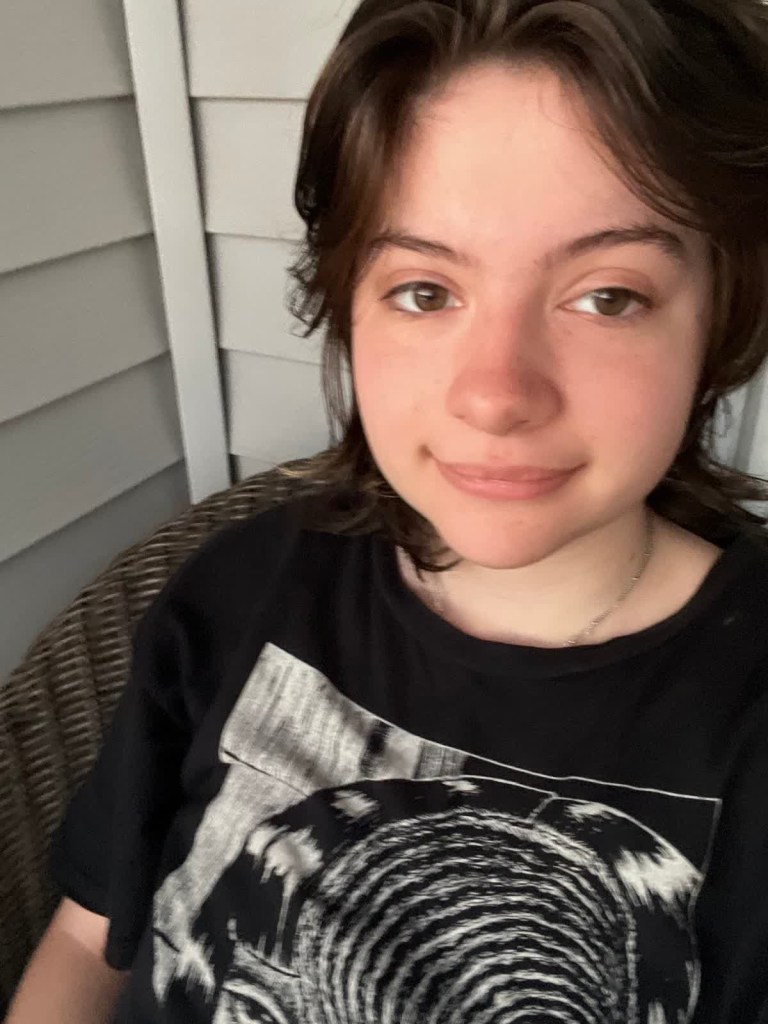
Charlie Bach (he/she) is a sophomore at Lycoming college who studies English Literature and French. She’s the assistant managing editor of The Tributary, and she enjoys writing poetry and literary fiction (while drawing cartoons on the side).
Martyrs
“If the mountains of Lebanon could tell us their story, we should see them dyed in the blood of martyrs…”
– My great aunt, Layyah Barakat (1858-1940)
As a child of the mulberry trees,
You knew the divine truth
Of the oranges and apricots that grew
Over a dark, endless ravine.
You plunged into that vast unknown,
Believing in His will, unwavering,
His faith in you.
“Those queer American missionaries,
Hide your children, away, away.”
Auntie, I know you to be tired
Of puppetry and massacres,
Hungry and weary, barefooted, half-naked,
The smell of blood where once was sweet,
Fruitful, blooming flowers. Now it’s acidic, metallic,
And your bible’s ripped open, shredded by Abrahamic men. Western Christians, Eastern Muslims,
Those who pierced into your father,
Cutting down his prayers
With a carving knife.
Shaping, skinning, butchering…
He bled out in front of your eyes.
I understand why you’re a traveller, Layyah,
Dodging whizzing bullets, stepping over corpses…
Marching forward into His uncertain creation,
While dyed in the blood of martyrs.
“McGlue” Review
One day, back when I used to work at a closing Rite Aid, I arrived an hour early to my shift. Not wanting to spend any extra time in a building foggy with mold and dust particles, I loitered in the nearby Starbucks to read the entirety of McGlue, Ottessa Moshfegh’s first novella.
I was with it for the first 50 pages, and then a switch flipped, and I promptly got tired of it. I enjoyed Eileen despite its dark themes, and I liked the movie rendition for it as well. However, something about Moshfegh’s amateurish style did nothing to suspend my disbelief at the countless historical inaccuracies. Maybe it’s my fault for diving so deep into queer history, but when an author writes visceral and upsetting homophobia into their novella, is it too much to ask for it to be historically accurate?
I’m talking about the character named the f-slur. That’s what an actual character is called. Or, it’s more what the narrator calls him out of a feeling of internalized homophobia (I doubt his mother saw him as a newborn and decided to name him that). McGlue, the narrator, is both attracted to him and cruel to him because of it. Here’s the thing, though: the f-slur as it’s used repeatedly throughout the novella was not used in this way until the 1910s-1930s. Currently, we are on a sailing vessel in 1851.
One thing I’ve learned is that words are always older than we think they are, but 80 years is a bit of a stretch. In my humble opinion, when writing sensitive topics you always need to do a little extra research to be sure you portray it correctly. Words, especially slurs, have power. McGlue felt burdened by its lack of care. For this reason, I can’t recommend it. On a more positive note, the care Moshfegh gave her stories only increased the more she wrote, and she remedies this problem in her later work.
 The Tributary